I somehow missed the Sonoma Film Festival, but you can still catch the last few days; it ends Sunday. So does the Women’s Film Festival, but that one opens tonight. The San Francisco International Film Festival opens Thursday.
B Farewell, My Queen, Castro, Thursday, 7:00. What was it Versailles like in the final days of the French monarchy? Was the court panicked? In  denial? Did anyone realize that they would soon lose their heads? Benoît Jacquot creates an answer to these questions in this small yet visually impressive drama set in the French court in July of 1789. Although seriously marred by an uninteresting central character, Farewell, My Queen gives us a peak into a different world–a beautiful palace in which the realities of normal people seldom intrude. But it is utterly dependent on a bigger world that it thinks it controls, and it can’t last forever. I wish this picture had run longer. The San Francisco International Film Festival‘s opening night show.
A+ Rio Bravo, Pacific Film Archive, Saturday, 8:00. In his second western (more than a decade after Red River) Howard Hawks went for a much lighter touch, and achieved an entirely different kind of greatness. The story concerns a small-town sheriff (John Wayne at his most cuddly) holding a frontier jail against the well-financed crooks who want to free the murderer inside. His only deputies are a drunk (Dean Martin) and an old man with a bad leg (Walter Brennan). Rick Nelson turns up as the coolest, calmest variation on that western archetype, The Kid, and sings a a couple of songs with Martin. Angie Dickinson plays Wayne’s love interest, and their scenes together border on another Hawks specialty: screwball comedy. Funny, suspenseful, and largely character-driven, with some great action, Rio Bravo is the ultimate escapist western. Part of the series Howard Hawks: The Measure of Man.
B+ Lost in Translation, Castro, Friday, 7:15. I can’t believe it’s been almost a decade since Sophia Coppola introduced us to Scarlett Johansson, and gave Bill Murray his best performance since Groundhog Day. And she did it by making a film in which nothing of note happens. Murray plays an American movie star in Tokyo to shoot a whiskey commercial. Johansson plays the bored wife of a photographer. They sense a bond. And what you expect to happen never does. But that’s okay because it probably wouldn’t happen in real life, either. Coppola allows us to enjoy these people’s company, and their reaction to a foreign culture, for 104 minutes. That’s entertainment enough. This is the first feature in a Japan-themed MiDNiTES for MANiACS triple bill.
B+ Fight Club, Camera 3 Cinema, Thursday. This is one strange and disturbing flick. Edward Norton wants to be Brad Pitt. Who wouldn’t? Pitt’s a free-spirited kind of guy and a real man. Besides, he’s shagging Helena Bonham Carter (who plays an American, and would therefore never use the verb shag). On the other hand, he just might be a fascist. Or maybe…better not give away the strangest plot twist this side of Psycho and Bambi, even if it strains credibility more than a Glenn Beck conspiracy theory. And Bonham Carter gets to say the most shocking and hilariously obscene line in Hollywood history.
A- Double Bill: The Mark of Zorro (1940 version) & Queen Christina, Stanford, Friday and Saturday. Antonio Banderas wasn’t the first ridiculously handsome face to don a  mask and save the peasants of Spanish California. Tyrone Power made the role of Zorro his own in the second and best movie to actually follow Johnston McCulley’s original novel. Power, who was bisexual in real life, plays Don Diego as an effeminate fop, and his masked alter ego as dashing masculinity. The movie is witty, fun, politically progressive, and includes one of the best sword fights ever to kill off Basil Rathbone. Queen Christina, on the other hand, is not really a great movie, but it reunites Greta Garbo and John Gilbert–a major couple on and off the screen in the 1920s.
B The Mark of Zorro (1920 version), Stanford, Sunday. This 1920 adventure flick is where it all began. Douglas Fairbanks bought the rights to a then-recent, serialized novel, projected his already-famous athletic comic hero into a romanticized past, grabbed a sword, and invented the movie swashbuckler. There are better Zorro movies (including Fairbanks’ sequel, Don Q, Son of Zorro), but no other catches the birth of a genre. With Dennis James accompanying on the Stanford’s pipe organ.
A The Manchurian Candidate (1962 version), Castro, Sunday, 6:30. Bad dreams keep bothering Korean War veterans Lawrence Harvey and Frank Sinatra. Were they brainwashed by Communists? And where do the rabid anti-Communists fit in? Easily the best 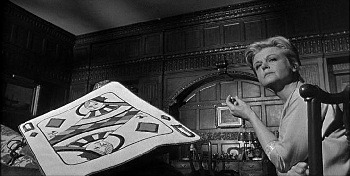 political thriller to come out of the cold war, The Manchurian Candidate finds villains on both political extremes. As the nominal hero, Sinatra gives the best acting performance of his career, but Angela Lansbury steels the film as as the screen’s most evil mother–a woman of outsized beliefs and a burning hatred of anyone who disagrees with her. Read my Blu-ray review. On a double bill with The Parallax View.
B The Graduate, Alameda, Wednesday and Thursday. Maybe it’s no longer the breakthrough movie it was in 1967, but The Graduate is still a well-made romantic comedy with serious overtones. And, of course, it gets Bay Area geography all wrong.
A Red Desert, Castro, Wednesday. No one has ever called Michelangelo Antonioni’s study of pollution and madness a thriller, yet it filled me with a  sense of foreboding and dread that Alfred Hitchcock seldom matched. Monica Vitti holds the screen as a housewife and mother struggling to maintain her slipping sanity. It’s no surprise she’s breaking down; her husband manages a large plant that’s spewing poison into the air, water, and ground (Antonioni made absolutely sure that his first color film would not be beautiful). Through her mental deterioration, she plans to open a shop (without any clear idea of what she’ll sell), flirts with one of her husband’s co-workers (Richard Harris, dubbed into Italian), worries about disease, and attends a party that stops just short of an orgy. Carlo Di Palma’s brilliant camerawork adds to the sense of mental isolation; I’ve never seen out-of-focus images used so effectively. On a double bill with Zabriskie Point.

 Bayflicks