You’ve probably read about 3D movies doing disappointing business lately. Some say that today’s 3D craze is bottoming out. Others argue that, like a killer in a bad horror movie (probably shot in 3D), the stereoscopic format will rise again.
But I say: Look to Hollywood’s past for perspective on 3D’s future. Will it swiftly take over the American movie industry, the way sound did in the late 1920s? Will it slowly grow over decades from a gimmicky novelty into the established norm, as did color. Or will it all but disappear after a brief burst of enthusiasm, as it did nearly 60 years ago.
All of these new formats have one thing in common: When they were new, critics and other defenders of the cinematic art detested and denounced them all. Keep that in mind when you read one of today’s critics (including me) complain about the inherent inferiority of 3D.
First Possibility: A Sound-Like Revolution
The Jazz Singer—the first feature with (very limited) talking sequences and the one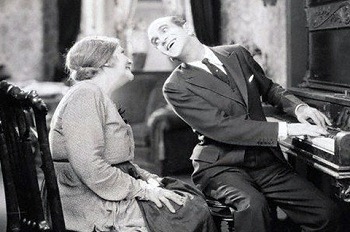 that got people excited about sound–premiered on October 6, 1927. Two years later, the silent movie was all but dead, at least in Hollywood (it continued in independent film and in other countries for a few years). The change, which turned stars into has-beens, bit players into stars, and countless gainfully employed musicians into starving artists, happened so fast people scarcely believed it.
The lightning transition even left the studios with brand-new but outdated product. Scared that audiences would no longer accept silent films, they quickly converted many of them into “talkies.” They’d shoot one or two dialog sequences, add recorded music and sound effects to the rest of the movie, and advertise it as something new and exciting. Audiences caught on to the deception quick, and labeled these pictures “goat gland films” after a impotence cure promoted by a well-known quack.
Sound familiar? Remember the post-Avatar 3D rush, when the same studios digitally converted flat movies like Alice in Wonderland into fake 3D?
Of course, the simple fact that theaters are still filled with 2D movies tells us that 3D won’t (or rather, hasn’t) come in as quickly as sound. While I wouldn’t entirely discount the possibility of a quick transition in the near future, the slow gains 3D has made since Avatar, combined with recent ticket sales, doesn’t give this scenario good odds.
Second Possibility: A Color-Like Evolution
Unlike talkies, color movies came in very slowly. The first silent feature shot and presented in color, Toll of the Sea, came out early in 1922. The first really huge color megahit, Gone With the Wind, premiered in 1939. A decade later, Hollywood was still putting out more black and white movies than color ones, although the gap was narrowing. It wasn’t until the mid 1960s that black and white all but disappeared.
Color remained little more than a gimmick until well into the 1930s.  The quality improved greatly with Technicolor’s three-strip process in 1932, but hard economic times kept it from catching on quickly.
Slowly, over the years, it conquered one genre after another. First, cartoons went all color. Then the big-budget blockbuster genres: fantasies, musicals and historical epics. With the exception of musicals, which are barely made anymore, these are the same genres where you’re most likely to see 3D today. Hollywood continued to make serious dramas and adult-oriented comedies in black and white until 1966.
This sort of slow transition seems quite plausible for 3D. If we assume that Avatar is 3D’s Gone With the Wind (which makes sense considering its huge commercial success and excellent use of the medium), then we’re currently in the 3D equivalent of 1941. We could easily have another 20 years before 2D movies disappear completely.
Final Possibility: 3D Repeats Itself
Late in 1952, a dreadful, low-budget jungle movie called Bwana Devil launched Hollywood’s first infatuation with 3D. It didn’t last. The craze had run out of steam 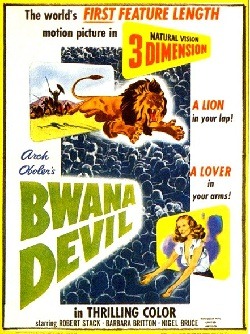 by early 1954.
No history I’ve read has really pinned down why it died so quickly. (It certainly wasn’t the crude red-and-green glasses; 1950’s 3D used polarized glasses much like the ones used today.) One possibility: Another enhancement, the wide screen, also came in big in 1953, and became the norm as swiftly as had sound a quarter century earlier. Perhaps audiences preferred a new format that didn’t require special glasses.
Another possibility: 3D projection was a tricky business in those days, requiring two projectors running in perfect sync. It’s quite likely that 3D looked great in some theaters, and awful in others. As I discovered last week, that’s still an issue today.
Or maybe audiences just grew tired of 3D once the gimmick wore off. Clumsy glasses, dark images, and a tendency for headaches might not help produce a positive movie-going experience.
If that’s the case, it’s doomed once again. As Technologizer editor Harry McCracken tweeted last Thursday, “If all we had was 3D TV/movies/games, and someone invented 2D, it would be hailed as a breakthrough. ‘No glasses–and it’s sharp!’"


One thought on “3D: Is It the Next Sound, the Next Color, or Just the Next 3D”
Comments are closed.