he Jewish Film Festival is up and running. I’ve separated my festival-related recommendations and warnings from the others.
 Wonderful Town, Kabuki, opens Friday. Wonderful Town has nothing to do with the 1953 Broadway
 musical of the same name, although a few songs would liven up this very dull creature from Thailand. The story concerns a young architect who comes to a small coastal town, one that was devastated by the 2004 tsunami, to help rebuild on a luxury resort. He stays at a much plainer hotel, and falls in love with the woman running the place. She’s moderately charming, he isn’t, and everything moves like a tortoise on downers. Allegedly, this Thai drama examines the long-term psychological aftereffects of disaster. Any real ideas about these two people as individuals or post-traumatic stress disorder in general never get through the telling. Read my full review.
Brainwash Movie Festival, Mandela Village Arts Center, Oakland, Friday and Saturday, 9:00. Located in a parking lot near the West Oakland BART station, the 14th Annual Brainwash Movie Festival screens odd shorts in what it describes as a “Drive-In/Bike-In/Walk In” outdoor theater. However you come, you need to bring an FM radio with you to catch the audio. Each night they screen a different collection of shorts.
 Stop Making Sense, Red Vic, Tuesday. Jonathan Demme and the Talking Heads realized that a concert
 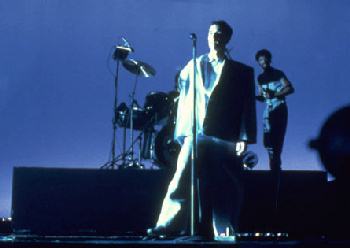 film doesn’t have to be a documentary. They don’t show us the audience or the backstage; just the performance (actually compiled from three performances). But what an amazing piece of rock and roll performance art they provide! Strange dance moves, great riffs, puzzling and possibly profound lyrics, and a very big suit, all backed by a beat that makes you want to get up and dance.
Raging Bull, Pacific Film Archive, Saturday, 8:30. Martin Scorsese put a cap on 70’s cinema with this study of boxer Jake La Motta. It isn’t an easy film to watch; the experience is not unlike a good pummeling, but it’s absolutely worth it. Part of the PFA’s United Artists: 90 Years series.
Comedy Shorts, Niles Essanay Silent Film Museum, Saturday, 7:30. Four shorts by the best: Chaplin, Keaton, Lloyd, and Laurel & Hardy. The L&H short, Liberty, is one of their best. I can also vouch for Chaplin’s One A.M. and Keaton’s The Paleface. Judy Rosenberg at the piano.
White Heat, Cerrito, Saturday, 6:00, Sunday, 5:00. James Cagney returned to the studio that made him famous for one last gangster movie in 1949. But this time, instead of a basically decent guy who has ma de a few mistakes, he got to play a psycho. But at least he loves his mother. Come to think of it, maybe he loves her a little too much. I’m not giving White Heat a grade because it has been years since I saw it. But I remember liking it very much. This Cerrito Classic will screen with Eddie Muller’s short film “The Grand Inquisitor”–20-minutes of slow-building dread leading up to a shocker of an ending. And classic noir star Marsha Hunt (now 90) can still send chills down your back.
Sweet Smell of Success, Pacific Film Archive, 7:30. . It’s been too long since I’ve seen Burt Lancaster’s Broadway noir for me to trust my memory with a wholehearted recommendation. But not by much. Lancaster risked his career by producing this exploration of the seamy side of fame and by playing a truly despicable character. The result, if I recall correctly, is fantastic. Tony Curtis co-stars, from a script by Ernest (North by Northwest) Lehman. Part of the PFA’s United Artists: 90 Years series.
 DOUBLE BILL: San Francisco & Showboat, Stanford, Wednesday through next Friday. A big, silly, mel
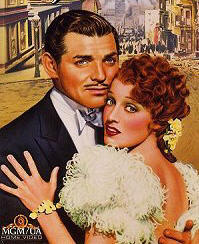 odramatic special effects vehicle made before that was Hollywood’s dominant genre, San Francisco is a classic example of code-era Hollywood trying to have it both ways. It celebrates non-conformist, hedonistic, open-minded joy, but covers itself in a thick layer of Christian moralizing that’s as annoying as it is laughable. But all the weaknesses disappear when the earth shakes and the fires break out. The 1936 version of Showboat was director James Whale’s chance to break out of the horror genre. It starts well, dealing with miscegenation and racism in ways surprisingly advanced for 1936, but it soon descents into dull lifelessness.
San Francisco Jewish Film Festival
Arab Labor, episodes 1, 2, and 3, Castro, Wednesday, 9:30. What does it mean to be an Israeli citizen and an Arab, especially if you’re not political or religious? How do you get on in the country of your birth where you’re treated as an alien? This Israeli sitcom explores that question in ways both insightful and hilarious. Amjad, an Arab reporter working for a Jewish newspaper, struggles with indignities, tries to fit in (buying, in the first episode, a “Jewish” car so he won’t be stopped at checkpoints). Things aren’t helped by his scheming father, his love-sick Jewish photographer friend, or the wife who’s always one step ahead of him (actually, the wife helps him quite a bit). The characters don’t conform to ethnic stereotypes, but they’re always expecting others to do so. The San Francisco Jewish Festival will screen all nine episodes (I’ve seen seven of them) in blocks of three episodes each, including a 3-admission marathon on August 3 at the Jewish Community Center.
 The Secrets, Castro, Monday, 9:30. This sexy spiritual journey (the best kind) looks at two young women trying to change the extremely parochial world of ultra-Orthodox Judaism from within. Th
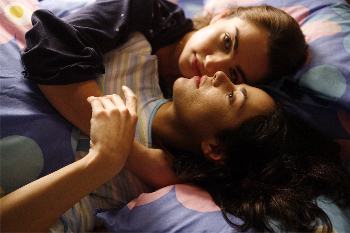 at’s not an easy–or perhaps even a possible–goal. The young women in question are the scholarly daughter of a respected rabbi (Ania Bukstein), and a French rebel (Michal Shtamler). They meet at a women’s seminary in Safed, where they secretly undertake the subversive task of helping a dying murderess prepare to meet G*d. They also discover a mutual sexual attraction and fall in love. Writers Hadar Galron and Avi Nesher (who also directed) successfully delve into an extreme and often cruel form of Judaism most of us haven’t experienced, and raise questions about forgiveness, repentance, love, and the need both to conform and to rebel. Part of the Jewish Film Festival.
Sixty Six, Castro, Saturday, 7:30. Twelve-year-old Bernie (Gregg Sulkin) sees his upcoming bar mitzvah, with its chance for him to be the center of all attention, as the salvation from his near-invisible life. But then everything that can go wrong with the family’s finances does, making a lavish party impossible, and the big event’s date conflicts with soccer’s Super Bowl–the World Cup. That’s a bad conflict in 1966 England, when Great Britain’s team was winning game after game. It doesn’t help that his father is a loser and his older brother (who got a big party for his bar mitzvah) is a sadist. Director Paul Weiland and his writers paint a bittersweet, funny story of a boy becoming a man under very stressful conditions. Sixty Six might receive theatrical distribution in the future.
 Loves Comes Lately, Castro, Sunday, 7:45. A grand-niece of Isaac Bashevis Singer once told me that the great writer didn’t realize that women threw the
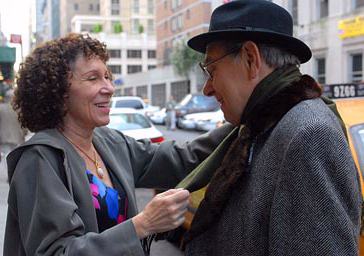 mselves at him because he was famous; he thought he was irresistible. Such confused thinking permeates Jan Schütte’s clumsy adaptation of three Singer stories. Love Comes Lately follows the adventures of a short-story writer who’s an obvious Singer alter-ego, and dramatizes two short stories whose protagonists are obviously this alter-ego’s alter-egos. Otto Tausig plays all three characters, and yes, they’re all irresistible to women. Schütte manages a few good scenes, but the movie goes nowhere and leads to nothing. Strangely, this mediocre film won not only the festival’s coveted Centerpiece spot, but also a future theatrical run.

 Bayflicks
