I spent Saturday with Jean-Claude Carrière, Tilda Swinton, and John Turturro. Good company. (If you don’t recognize Carrière’s name, that just shows how badly we actor-and-director obsessed film fans disrespect screenwriters.)
Yes, I’m talking about the San Francisco International Film Festival, where I devoted my day to big events with big names rather than actually watching movies (although I caught a couple of those, too).
Carrière received this year’s Kanbar Award for Excellence In Screenwriting. With a 128-title filmography that includes Diary of a Chambermaid, The Discreet Charm of the 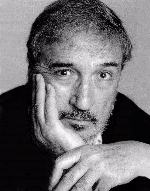 Bourgeoisie, The Tin Drum, and The Unbearable Lightness of Being, he deserves it.
Film critic David D’Arcy interviewed the extremely amiable and talkative Carrière before a festival audience. The issue of authorship came up; it always does with screenwriters. “We have to reach another dimension,” Carrière argued. “It’s not the writer’s film. It’s not the director’s film. It’s the film.” He added that “When a writer becomes a screenwriter, he must know he’s part of a team.”
D’Arcy asked him about adapting other writers’ works–“novels and stage plays”–to the screen. “The main difference is [adapting the works of] writers who are alive versus writers who are dead. Living writers are easier because you can talk to them.– That surprised me; I would have assumed that dead writers are easier because they can’t complain.
After the interview, D’Arcy opened the floor for Q&A with the audience. I asked about writing in foreign languages (he’s written English- and German-language films as well as those in his native French). After saying he could talk to me for hours on that subject (I’m game), he explained that he calls in a writer of the appropriate nationality to be the final judge. He also discussed the importance of vernacular; for instance, you can’t use American slang in an American, English-language movie where the characters would realistically be speaking Czech. (That example wasn’t pulled from thin air. Phillip Kaufman, for whom he wrote The Unbearable Lightness of Being, was in the second row.)
After the discussion, the Festival screened Belle de Jour, which I haven’t seen in over 30 years. It’s still a very good film. The Pacific Film Archive is following the Festival with a Tribute To Jean-Claude Carrière series.
Later that afternoon, actor Tilda Swinton delivered the State of the Cinema address in the form of a letter to her 8-year-old son, attempting to answer a question he had recently asked her: “What did dreams look like before there was cinema?”
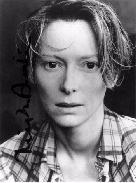 She didn’t offer anything like a concrete answer (not as if we expected one), but she spoke elegantly, rhapsodizing about her love of the art form, about “What cinema is and why we need it. [And] why it’s worth the fight.” She proclaimed herself “hopeful to my boots that it’s never going away.-”
She admitted that that she feels like “a fraud” because she knows nothing about the skill of acting. She discussed how DVDs have educated everyone about the art, so that the fishermen in her remote Scottish village request their rentals by director. And she offered her theory as to why independent films are generally superior to Hollywood product: The big-budget movies, because they have the money to be perfect, take their time and lose their spontaneity.
I closed the night with Romance and Cigarettes (the movie, not the actual commodities), a musical tragi-comedy about a marriage threatened by adultery. It’s a strange sort of musical, written and directed by John Turturro. The songs are familiar hits, and for the most part the cast lip-synchs the original recordings. The dancing looks more exuberant than professional. The cast is outstanding, including James Gandolfini, Susan Sarandon, Kate Winslet, Steve Buscemi, Christopher Walken, and Mandy Moore.
With its corny songs and dances, raunchy humor, and entirely loopy logic, the first half of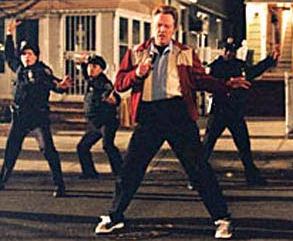 Romance and Cigarettes is gut-bustingly funny. And yet there’s something real underneath it. We’ve all been in shaky relationships, and we’ve all wanted to break into song and dance on the street (at least I hope it’s not just me). But as Romance and Cigarettes turns serious in the second half, it finds itself on less secure ground. Turturro can’t quite manage the tricky transition from tomfoolery to tragedy.
After the movie, Turturro came on stage for a little Q&A. He had had the idea of characters lip-synching familiar songs before seeing anything by Dennis (The Singing Detective) Potter, who, he admits, “thought of it first.” He described the set as one where “We laughed a lot,-” a spirit that carried over into the final film. And he limited his use of professional choreographers because he wanted the dancing to “look like [something you’d do] in the privacy of your bedroom.”
There are lots of fun things you can do in the privacy of your bedroom, but the movies below are best viewed in a crowded theater.
Recommended: Tsotsi, 4Star, opening Friday. Tsotsi is so good it’s difficult to watch.  Writer/director Gavin Hood asks for no sympathy for the violent young thug at the film’s center (Presley Chweneyagae), even as he shows you the dire poverty that created this scary young man. Early in the film, the title character highjacks a car, shooting a woman in the stomach. Then he discovers a baby in the back seat. The thug has no idea what to do, so he finds himself caring for the child, and he slowly begins to soften. This is a tense, scary, vicious, yet ultimately beautiful film about humanity and redemption.
Recommended, with Reservations: Ice Age: The Meltdown, Elmwood, opens Friday. Not in the same class as Shrek or The Incredibles, or even of the first Ice Age movie, but still an entertaining diversion for an afternoon with the kids. The best scenes (which have nothing to do with the rest of the movie) involve a sort of proto-squirrel who may be computer animation’s answer to Wile Coyote.
Noteworthy: The Discreet Charm of the Bourgeoisie, Pacific Film Archive, Saturday, 6:30. It’s been entirely too long since I’ve seen what I remember as my favorite Luis Buñuel film. An extremely pointed comedy where fantasy and reality merge (hey, this is Buñuel), Discreet Charm tells the tale of a small group of wealthy friends whose bad luck continually thwarts their attempts to eat dinner. Part of the PFA’s tribute to screenwriter Jean-Claude Carrière, although it’s more like a tribute to Carrière and Buñuel, as they are showing nothing the former wrote for another director.


