Shakespeare, Truffaut, and killer Androids (and I don’t mean smartphones).
Here in the Northern Hemisphere, which includes the Bay Area, December is the darkest month of the year. It’s cold. People look for indoor activities. It’s also, outside of summer, the biggest month for movie-going. And yet, no festivals this week or, ASAIK, this month.
But there are some movies:
A- Macbeth Double Bill: Throne of Blood & Macbeth (1971 version), Castro, Sunday. Kurosawa stands Shakespeare on his head in Throne of Blood, a haunting, noh- and  kabuki-inspired, loose adaptation of Macbeth. Toshiro Mifune gives an over-the-top but still effective performance as the military officer tempted by his wife (Isuzu Yamada) into murdering his lord. The finale–which is far more democratic than anything Shakespeare ever dared–is one of the great action sequences ever. Read my Kurosawa Diary entry. Roman Polanski’s version of Macbeth—his first film after the brutal murder of his wife, Sharon Tate—uses Shakespeare’s language and follows the original play closely, yet still manages to be very cinematic and, for its time, shockingly violent.
A- Shoot the Piano Player, Castro, Thursday. After stunning the world with The 400 Blows, François Truffaut tried something very different—a film noir that’s unlike any other (including Goddard’s Breathless, which Truffaut wrote around the same time). Charles Aznavour stars as a nightclub pianist with a past—he was once a big name in the classical music world. He’s going by a different name, now, but that isn’t enough to hide him from his gangster brother, or the brother’s rival gangsters. Truffaut moves, for the most part effortlessly, between suspense, tragedy, and outrageous comedy in telling this story. On a double-bill with another Truffaut film, The Soft Skin.
A Blade Runner (Director’s Cut), SFMOMA, Thursday, 7:00. Based on Philip K. Dick’s novel Do Androids Dream of Electric Sheep, Blade Runner remains surprisingly thoughtful for ’80’s sci-fi–especially of the big budget variety. It ponders questions about the nature of humanity and our ability to objectify people when it suits our needs. Yet it never preaches. The script’s hazy at times; I never did figure out some of the connections, and a couple of important things happen at ridiculously convenient times. But art direction and music alone would make it a masterpiece. I’ve written more on this film.
C- The Bride Wore Black, Pacific Film Archive, Saturday, 8:35. François Truffaut loved Hitchcock’s work, so it’s inevitable that he would eventually try to make a Hitchcockian picture. But just as Woody Allen’s work suffers when he tries to imitate Bergman, Truffaut couldn’t really manage the dark humor or the edge-of-your-seat suspense of his hero. (At least he didn’t manage it here. He comes closer in Shoot the Piano Player.) There’s no real rooting interest, and therefore no suspense, in this story of a young widow (Jeanne Moreau) out to murder the men who killed her husband on their wedding day. The picture comes off as little more than an experiment in Hitchcockian style without Hitchcockian content.
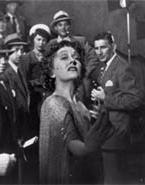 A Sunset Boulevard, Stanford, Friday. Billy Wilder’s meditation on Hollywood’s seedy underbelly is the flip side of Singin’ in the Rain (now that would make a great double bill). Norma Desmond is very much Lena Lamont after twenty-two years of denial and depression. And in the role of Norma, Gloria Swanson gives one of the great over-the-top performances in Hollywood history. On a double-bill with Five Graves to Cairo, which I’ve yet to see.

 Bayflicks