With The Artist finally playing locally, I thought it would be fun to look at other post-silent movies with little or no dialog.
Cinema, in its purest form, is a visual art. What it can do without words has always been more powerful than what it can do with them.
If I ran my own revival house cinema, I would put together a series on feature films, made after the death of silent movies, that use little or no dialog. But since I don’t own a theater, I’ll just share with you the movies that I’d include in this series. Most of them are available on DVD—at least from Netflix–and I’ll note the exceptions. Of course, seeing them at home can never equal the theatrical experience.
And just in case someone asks, here are three pictures that I wouldn’t include, and why:
- City Lights: The silent film wasn’t quite dead when Chaplin made this masterpiece, so it doesn’t qualify.
- Brand Upon the Brain: I haven’t seen it, and therefore have no opinion on it.
- Silent Movie: I saw it long ago, and hated it.
None of these films are, strictly speaking, silent. They all have soundtracks, and were not meant to be shown with live accompaniment. But they’re as close as we come these days, and a couple of them are very close, indeed.
WALL-E: I’d start the series with the most commercial movie in the lot, even if it has  more dialog than any other film on this list. It still has astonishingly little—and none at all for the first (and best) third. But when Disney finances your big-budget family entertainment, it takes guts to make an almost dialog-free film, especially one that looks closely and critically at such consequences of our consumer culture as garbage, obesity, and planetary destruction. WALL-E wimps out in the third act, and not only because that’s where it becomes relatively talkative. As the end approaches, the picture becomes much more conventional, with an action finish leading to an unlikely and unsatisfying happy ending. Those let-downs were probably inevitable, and while they diminish the film’s achievements, they don’t destroy them. Read my full review.
Modern Times: Charlie Chaplin used minimal dialog in what was probably the last 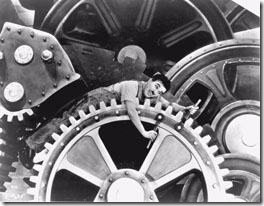 mostly-silent film made by someone who became rich and famous making real silent pictures. But leave it to Chaplin to call an extremely anachronistic movie Modern Times. Nevertheless, the name fits, because Modern Times is about assembly lines, mechanization, and the scarcity of jobs—very real issues in 1936. Chaplin’s tramp moves from job to job and jail to jail as he tries to better his condition and that of an underage fugitive (Paulette Goddard, his then lover, future wife, future ex-wife, and the best leading lady of his career).
Mon Oncle: This may be the funniest visual comedy made after the death of silent film. In the 70+ years since Chaplin talked onscreen, Jacques Tati has 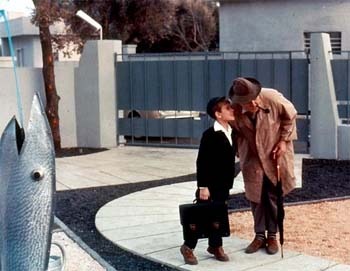 been the closest thing we’ve had to a silent comedian–writing, producing, directing, and starring in a handful of brilliant, dialog-light comedies. The slight story here looks at a mischievous boy, his image-conscious parents, and their disapproval of the mother’s unemployable brother–Tati’s onscreen persona, Monsieur Hulot. But that’s just an excuse for a wonderfully loopy comedy in that quiet Tati style. I discuss the film in more detail here.
Naked Island: This dialog-free Japanese drama from 1960 needs neither subtitles or a plot. It focuses on a nuclear family living on and  farming a tiny island in what appears to be a pretty large harbor. Their life is tough beyond measure. The island doesn’t even have enough water for their needs; several times a day they row to a larger island, fill four large wooden buckets, row back, carry the buckets up a steep incline, and water their crops. Yet they persevere through the seasons and through heartbreak. This is the only film in the group that’s in no way a comedy; It’s also not available in this country on DVD. But you can stream it on Hulu Plus.
Triplets of Belleville: In 2003, a new master of dialog-lite cinema emerged from France: Sylvain Chomet. An animator in the old-fashioned, hand-drawn style, his work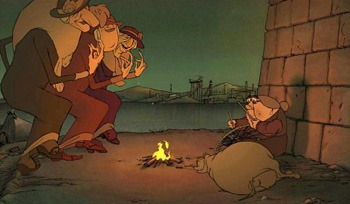 is marked by a unique, quirky humor. His first feature involves a French champion bicyclist who’s kidnapped by mobsters and brought to America to…never mind, it’s just too weird to explain. But who cares? The jokes are funny, the visuals are clever and original, and the music swings (the triplets of the title are an aging big band trio).
Idiots and Angels: Bill Plympton made a very bizarre, dark, funny cartoon, which shouldn’t surprise anyone who knows his work. It’s also entirely dialog-free, unless you count the occasional grunt. This story of a  lonely, angry, and all-together rotten man who inexplicitly sprouts angel wings will make you grimace as well as laugh. How rotten is he? At one point he pushes a tear of empathy back into his eye. Dialog-free, Idiots and Angels reveals its characters by showing us their actions and their daydreams, which are mostly about money and undeserved glory. But as evil as the man may be, the wings themselves insist on virtue. Plympton has created a dreadful world filled with dreadful people, yet allows something magical and wonderful to come out of it.
Playtime: Jacques Tati, again. Here Monsieur Hulot mingles with American tourists and ![playtime[1]](https://bayflicks.net/wp-content/uploads/2010/01/playtime.jpg "playtime[1]") assorted other specimens of humanity adrift and befuddled in a very modern Paris. That’s all there is of plot in Tati’s large-scale comedy, and that’s all that’s needed. On one level, Tati is commenting on modern architecture. On another, he’s just making us laugh in his odd, almost meditative way. And even when you’re not laughing, you’re fascinated by the little details of Tati’s city-sized universe. Tati spent (and lost) a fortune on Playtime, building a giant set and shooting the movie in 65mm for 70mm release, and the result is ours to enjoy…immensely.
assorted other specimens of humanity adrift and befuddled in a very modern Paris. That’s all there is of plot in Tati’s large-scale comedy, and that’s all that’s needed. On one level, Tati is commenting on modern architecture. On another, he’s just making us laugh in his odd, almost meditative way. And even when you’re not laughing, you’re fascinated by the little details of Tati’s city-sized universe. Tati spent (and lost) a fortune on Playtime, building a giant set and shooting the movie in 65mm for 70mm release, and the result is ours to enjoy…immensely.
Cumbia Connection: Can someone make a silent musical? René Villarreal comes  close with this vibrant, sexy tale of a love triangle in Monterrey, Mexico. There’s almost no dialog, or singing, but as the name implies, the never-ending cumbia music drives the story. A videographer falls in love with a beautiful thief. She already has a boyfriend, but that’s okay—she doesn’t mind having two. The music plays to vibrant colors, lots of dancing, and steamy, semi-explicit soft-core sex.
The Illusionist: In retrospect, it seems almost inevitable that Jacques Tati and Sylvain Chomet would collaborate on a dialog-lite comedy—even though Chomet made his  first picture 16 years after Tati’s death. For The Illusionist, Chomet animated a never-produced Tati script, and drew the protagonist not only to look like the great comedian but to move like him, as well. The story, about a magician in a world that no longer values his craft, and a young girl so naïve she believes his tricks are real, is sadder and more wistful than Tati’s own work, but still manages to be funny.
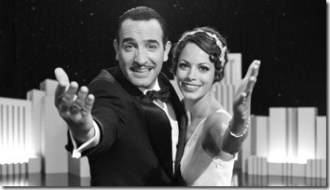
The Artist: Well, of course. This one isn’t available in any home video format yet, but it will be. Read my full review.

 Bayflicks
So excited to see The Artist. Nice look at other silent films.