B+ Period action film
One expects monks—at least of the Buddhist variety—to abhor violence. Yet the Shaolin Temple is known as an important center of Kung Fu. The monks in Benny Chan’s new period piece hate bloodshed, but they still get to beat up a lot of bad guys.
The movie starts with a pacifistic statement. Monks search the remains of a battlefield for survivors. There aren’t many, and not all the victims were soldiers. The camera lingers on the dead hand of a young child, clutching a flower. Chan wants us to know without a doubt that the people who caused this massacre are very, very bad.
Yet Chan is going to make us care about and sympathize with the man most responsible. We’ll watch him fall from power, go into hiding, and find humility, peace, and redemption amongst the Shaolin monks.
But this is a big-budget crowd-pleaser, so Chan also throws in a lot of entertaining action, as well as some comedy .
Chan sets his story in the early 20th century, when China’s central government was collapsing, western governments were looking to carve up the Chinese pie, and warlords fought ruthlessly over the spoils. General Hou Jie (Andy Lau) is one such warlord, and apparently a successful one. He’s just conquered Dengfeng with massive loss of life. He’s a loving father, husband, and older brother, but also a ruthless mass murderer.
But when he’s betrayed and overthrown, he finds himself at the mercy of the Shaolin Temple, a holy place which he had desecrated soon after his victory. Luckily, if there’s anything the monks are good at, it’s mercy.
They’re also good at fighting. For all its religious Zen posturing, Shaolin is first and foremost an action movie. Hou Jie must atone for his past life not merely with suffering and service, but with violence in the service of good, going up against the new—and even worse—warlord who has taken his place.
This time, the action scenes really do take second place to the story. They’re well choreographed and fun to watch, without the spatial incoherence common in so many current action movies. The cutting is fast, but not so confused that you lose track of who’s standing where and what they’re actually doing.
But the action scenes fall into other conventional traps, many specific to Hong Kong cinema. For instance, a villain who will do anything to get his way, completely at ease with mass murder, will holster his gun for some hand-to-hand combat. And for the big climactic fight, Chan and his five screenwriters (yes, you read that right) stretched both credibility and good storytelling pretty thin just to add explosions to the proceedings.
These failings, plus some painfully obvious symbolism at the ending, knock my grade for Shaolin down to a B+.
It probably would have been a flat B had Jackie Chan not turned up early in the 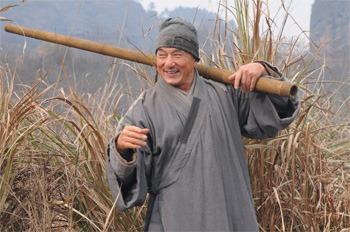 second act as the Temple’s cook. The character is simple but wise, and since he’s played by Chan, funny and loveable. Action stars often turn into character actors as they age, and Chan does it nicely, here.
Chan’s character says twice that he doesn’t know martial arts. Having Jackie Chan say that sets up some expectations. I’ll just say you won’t be disappointed—assuming you realize that Jackie Chan is now 57 and can’t do the sort of stunts that were once his trademark.
Speaking of stunts, there’s an early shot involving a horse that made me squirm. I couldn’t imagine how they could have shot it without crippling the poor beast. But at the end of the credits, the filmmakers assure us that no animals were harmed in making the film. Let’s hope that was true.

 Bayflicks
3 thoughts on “Shaolin”
Comments are closed.