I’d be hard-pressed to think of another film that’s anything like Jean Cocteau’s post-war fantasy. It’s a fairytale, told with a charming and often naïve innocence, and contains absolutely no objectionable-for-children content. But its slow pace and quiet magic never panders to unsophisticated viewers. About 30 years ago I saw a very young audience sit enraptured by it, but I can’t help suspecting that that is not a common experience.
This is a supremely atmospheric motion picture, and one that takes its magical story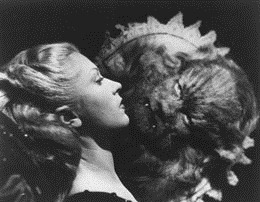 seriously. First Beauty’s father, than Beauty herself, must face the horrible Beast who, over time, proves himself kinder and more decent than most humans. He’s much kinder and decent than Beauty’s selfish and egotistical sisters, her weak brother, or her handsome but irresponsible suitor. The story itself contains considerable psychological complexity, even when it’s mixed with simplistic morality.
Cocteau turns this story into a one-of-a-kind experience by how he and his team create the two settings. Beauty’s home is a reasonably realistic merchant’s house in what looks to me like the early 17th century. He starts the story there with broad comedy, and soon replaces that with earnest melodrama.
But the magic begins, both in the story and the atmosphere, when he brings us to the Beast’s castle. There he creates a realm unlike any other. The walls and furniture seem alive, with human arms holding candelabras and human faces watching every move. The Beast commands the magic but is also trapped by it, and the result is haunting, beautiful, paranoia-inducing, and unlike anything you’ve seen before.
And yet Beauty becomes acclimated to this magic. In one of my favorite moments, well into the film, she takes a candelabra from one of those living arms with the casualness of turning on a light switch. Even magic can become ordinary, and there’s an odd comfort to that.
First Impression
This is a Criterion disc, so it’s a class act. You must wait for a few seconds after inserting the disc, but nothing annoying comes up. It goes directly to the opening menu.
How It Looks
Cocteau wanted to shoot Beauty and the Best in color, but the realities of the post-war French economy made this impossible. I’m glad. I can’t imagine color helping with these images.
The movie underwent an analog, film-based restoration in 1995. After scanning it for the this release, Criterion did extra cleanup manually. Despite a few film-based problems (including one very visible matte), this is overall a gloriously beautiful transfer. The image shines like a vintage nitrate print, with subtle shadings that do full justice to Henri Alekan’s cinematography and Christian Bérard’s and Lucien Carré’s design.
I do have one major objection. Cocteau followed the opening credits with a written introduction scrolling up the screen. Criterion presents this in the original French, with English subtitles. But the result, white English letters in front of white French letters, is difficult to read. They had other options; they could have scrolled an English translation, or used colored subtitles. I wish they had done one or the other.
How It Sounds
Finally I get to review a Blu-ray that contains the original mono soundtrack. Even better, that soundtrack is uncompressed mono, and sounds as good as an optical track from 1946 could be expected to sound.
And as good as it should sound.
There’s also a great-sounding 5.1 mix, but that’s not really a new mix, but a supplement.
And the Extras
Philip Glass wrote an opera, not just of the story Beauty and the Beast, but of this film. Its libretto, in French, was taken from the dialog. Glass wrote the music to time the singing with the film, which is supposed to be projected behind the live performers.
Criterion has included this opera, presented in a lossless DTS-HD Master Audio, 5.1 mix, as a supplement. Watching this movie/opera hybrid is an entirely different experience than watching the movie as it was intended, and quite beautiful and effective in its own right. The music changes the picture in many ways, making this a new interpretation of the tale. For instance, the Beast, now singing in a fine tenor rather than talking in a rough growl, seems more aristocratic and less dangerous in this version.
On the downside, there’s something disconcerting about watching people talk while you hear them sing opera. Their mouths don’t open enough for the sound coming out of them.
The disc also contains two commentaries, by Arthur Knight and Sir Christopher Frayling. They cover a lot of similar ground, so you can be excused for not listening to both. Frayling’s is the better one.
Criterion also includes three short films made for French television, trailers, and a collection of photos. A booklet that comes in the case contains some articles about the film and the opera, including ones by Cocteau and Glass.
There are other filmed fairytales, and even other versions of this one (and, yes, I liked the Disney version, too). But nothing else approaches Cocteau’s Beauty and the Beast. This is a great and unique motion picture, and Criterion has done it justice.
This Blu-ray disc will be available on July 19th. You can currently preorder it from Amazon, Criterion, and other retailers.

 Bayflicks
Disney really should tour this show! It was wonderful. I am a fan of movie and so this was the perfect show for me to see. The music gave me chills, the sets were surprisingly impressive. It was a great spectacle.
Beauty & the Beast has been my favorite broadway show, I’ve seen it 8 times and going back at least one more time before it sadly ends. I don’t want it to end, I’m so sad I made a petition… savebeautyandthebeast.com. if more people knew of it, there’d be plenty more signatures.