Cinequest opens Tuesday night, if only as a reminder that not all festivals open on a Thursday. But then, the Green Film Festival opens on Thursday.
And here’s something strange: There’s not a show in this newsletter I can give a grade to. No A‘s, no F‘s, and nothing in between. There are two movies here I really like, but one I haven’t seen in 20 years (which disqualifies it from a grade) and the other is one of three short subjects on  the program.
Oscar Parties, Balboa, Cerrito, Lark, Rafael, Roxie. See my recent post for details.
10 Year Anniversary, Niles Essanay Silent Film Museum, Saturday, 7:30. The Museum has been presenting films since February 2001, so it’s time for a celebration. The feature is Lilac Time (I haven’t heard of it, either), starring Gary Cooper as a WWI aviator and Colleen Moore as his French love interest. With three short subjects and Jon Mirsalis accompanying on a Kurzwell, which I think is a digital piano.
Silent Comedies of the 1920s, Pacific Film Archive, Friday, 7:00. The PFA is presenting three obscure silent  comic shorts on a night that I can’t attend (damn them). The only one of the three I’ve seen is "Pass the Gravy." I don’t want to give away too much about this Max Davidson two-reeler—let’s just say it involves feuding fathers, young people in love, a prize chicken, and one of the funniest dinners on film. If the other shorts are as funny, this will indeed be an evening of merriment. And since it’s part of the series and symposium, Cinema Across Media: The 1920s, it will presumably be an evening of education, as well.
The Harmony Game: The Making of Bridge Over Troubled Water, Balboa, Thursday. Documentary on the making of the Simon and Garfield album 40 years ago. I haven’t seen it, but I thought it was worth mentioning here, anyway.
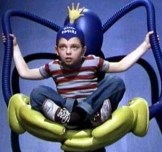 The 5,000 Fingers of Dr. T., Pacific Film Archive, Wednesday, 3:10. The only Dr. Seuss feature film made during his lifetime, and as creative, visually daring, and funny as any kid’s fantasy ever to come out of Hollywood. At least that’s how I remember it, many years from my last screening. Even the sets, photographed in three-strip Technicolor, look as if Seuss had painted them himself. The PFA will screen a vault print as part of the series, and class, Film 50: History of Cinema
Shoah, Pacific Film Archive, Part 1, Saturday, 5:00; Part 2, Sunday, 1:00. I admit that I have never seen this much-acclaimed, epic Holocaust documentary. When I was offered me a review copy recently, I turned them down. I couldn’t imagine spending more than nine hours watching a series of interviews about mass genocide. I’m not proud of that decision. But I thought I should note that the film contains no historical footage, is a recent addition to Roger Ebert’ Great Movies series, and has been restored for its 25th anniversary.

 Bayflicks