
Until yesterday, I’d never seen a film by Pier Paolo Pasolini. Feeling a need to rectify that, and suspecting that I couldn’t stomach Salo, I watched The Gospel According to St. Matthew last night.
If you have any sense of film history, you can’t watch this stark, low-budget, black-and-white, telling of the life of Christ without seeing it as a reaction to the Biblical blockbusters of its day. It was, after all, made in 1964. That’s five years after Ben-Hur, three years after King of Kings (AKA: I Was a Teenaged Jesus), and one year before The Greatest Story Ever Told (more accurately described as the most boring movie ever made).
Then there’s the issue of Pasolini, himself. How could the most reverent, spiritual, and faithful life of Jesus movie (and I mean faithful in both the religious sense and as an literary adaptation) be made by a self-proclaimed atheist? Perhaps his rejection of religion allowed him to see the story without sentiment or melodrama.
Pasolini stayed as close to the original text as cinematically possible, using only 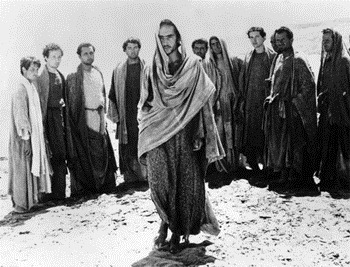 Matthew’s dialog (in Italian translation), and no dramatic embellishments. In the Italian neo-realistic tradition, he cast regular people instead of professional actors. He shot the film in the Italian district of Basilicata–a place that’s visually striking and looked–at least in 1964–like it hadn’t changed in millennia. The performers wore vaguely biblical costumes. I would guess that about two thirds of the film is comprised of close-ups.
The result is simply Matthew’s Gospel, illustrated with moving and talking photographs. It’s as if Pasolini is daring the audience, stating that this is what the Bible says happened. Deal with it.
I dealt with it, and I overall liked it, but I didn’t fall in love with Gospel the way many others have. (Consider, for instance, Roger Ebert’s opinion. Ebert, like Pasolini, is a former Catholic.) While I liked the audacity of the movie, and was captivated by the series of fascinating faces Pasolini puts on the screen, I found it difficult to completely throw myself into the story.
But then, I’ve always found Jesus wanting as a dramatic protagonist. He’s too perfect and all-knowing to allow much identification, or concern. That’s true even in a film that eschews drama.
Pasolini forces us to consider everything about Matthew, even the parts we’re not comfortable with. Raised Catholic but converted to Marxism, he simply puts the story that millions of people believe in front of us, and dares us to react.

 Bayflicks