I just found out about the Latino Film Festival, playing at various locations, while preparing this newsletter. It’s already running, and will continue to do so through this week and beyond. The Iranian Film Festival plays Saturday and Sunday at the San Francisco Art Institute. The The Isle of Wight 40th Anniversary Film Festival opens Wednesday at the Red Vic. And the Irish Film Festival opens Thursday at the Roxie.
Meanwhile, the Castro will be screening Chaplin films most of the week. I’ve lumped those together at the end of this newsletter.
A The 400 Blows, Red Vic, Sunday and Monday. François Truffaut helped launch the French New Wave and modern cinema with this tale of a rebellious boy on the cusp to adolescence. Shot on a very low budget, it follows young Antoine (Jean-Pierre Léaud in the first of six film in which he would play this role) as he cuts school, gets in trouble, discovers his parents’ marital problems, and refuses to fit in. Set to a brilliant jazz score, The 400 Blows captures the exhilaration and the horror (mostly the horror) of being 13.
B+ This is Spinal Tap, Lark, Sunday, 7:00. On a scale of one to ten, This is Spinal Tap rates an eleven. And if you didn’t understand what you just read, you haven’t seen the parody that put all “rockumentaries” in their place. That can, and should, be remedied. Part of the Lark’s Guys’ Night Out series, and a benefit for the Lark Theater Retire the Mortgage Capital Campaign.
B Dead Birds, Yerba Buena Center for the Arts, Thursday, 7:30. War is inevitable. That depressing message permeates Robert Gardner’s 1964 documentary about 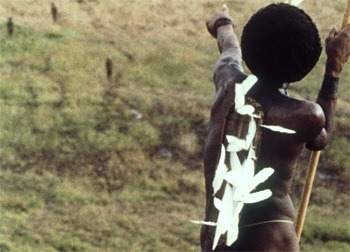 daily life amongst the Neolithic tribes of remote West Papua. Tribal battles break out regularly—almost ritualistically. When one occurs, it lasts until someone is seriously injured or killed. At that point, the losing side retreats to mourn, while the winning side retreats to celebrate. Gardner presents this tapestry of life with an almost willful lack of cinematic style. The narration is direct, neutral, and informative, and read in a flat, dry voice. You come away feeling that you’ve watched a simple presentation of fact. The YBCA will present a new 35mm print as the first screening of the series Others/Ourselves: The Cinema of Robert Gardner.
B Akeelah and the Bee, Pacific Film Archive, Thursday, 7:30. A talent for spelling gives Akeelah—a poor, eleven-year-old African American—a shot at escaping the ghetto. But first, she’s going to have to learn about more than words from her mentor, played by Laurence Fishburne. Yes, it’s inspirational, but that’s not always a bad thing. As part of the series Behind the Scenes: The Art and Craft of Cinema, the evening includes a discussion with producers Sid Ganis and Nancy Hult Ganis.
D+ Sin City, Pacific Film Archive, Saturday, 8:50. Graphic artist Frank Miller and filmmaker Robert Rodriguez collaborated on this visually stunning, technically cutting ![GraphicNovel_SinCity1[1]](https://bayflicks.net/wp-content/uploads/2010/09/graphicnovel_sincity11.jpg "GraphicNovel_SinCity1[1]") edge, but ultimately empty mishmash. In Miller’s world (the film is based on his graphic novel), every man is a killer, and every woman a stripper or a whore. Not that Sin City completely lacks heroes, it’s just that those heroes are violent vigilantes who don’t hesitate to torture people they don’t like. The result is grim, joyless, humorless, sexless (despite quite a few scantily-clad beauties), and totally disconnected from even the worst of the real world. But the mixture of black and white and color is striking. Part of the series Drawn from Life: The Graphic Novel on Film.
edge, but ultimately empty mishmash. In Miller’s world (the film is based on his graphic novel), every man is a killer, and every woman a stripper or a whore. Not that Sin City completely lacks heroes, it’s just that those heroes are violent vigilantes who don’t hesitate to torture people they don’t like. The result is grim, joyless, humorless, sexless (despite quite a few scantily-clad beauties), and totally disconnected from even the worst of the real world. But the mixture of black and white and color is striking. Part of the series Drawn from Life: The Graphic Novel on Film.
Charlie Chaplin at the Castro
A+ City Lights, Sunday. If you can attend only one Chaplin screening this week, go to this one. In his most perfect comedy, the little tramp falls in love with a blind flower  girl and befriends a suicidal, alcoholic millionaire, but neither of them know the real Charlie. The result is funny and touching, with one of the great tear-jerking endings. Sound came to movies as Chaplin was shooting City Lights, resulting in an essentially silent film with a recorded musical score composed by Chaplin himself. Cinema has rarely achieved such perfection. Rounding out the entertainment is one of Chaplin’s best shorts, “A Dog’s Life,” plus another pretty good one, “Sunnyside.”
A Modern Times, Monday. Leave it to Charlie Chaplin to call an  extremely anachronistic movie Modern Times. Why anachronistic? Because it’s a mostly silent picture (with a recorded score) made years after everyone else had started talking. Why Modern Times? Because it’s about assembly lines, mechanization, and the depression. Chaplin’s tramp moves from job to job and jail to jail as he tries to better his condition and that of an underage fugitive (Paulette Goddard, his lover, future wife, and the best leading lady of his career). With the mediocre short “Pay Day.”
A- Double Feature: The Great Dictator & The Kid, Tuesday. Chaplin made his one  good talkie on his first attempt, playing a dual role as a Jewish barber (really the tramp with an ethnicity and a voice), and Der Fooey, Adenoid Hynkel, Dictator of Tomania. Slapstick and dark satire seldom work so well together. Many people criticize the final scene, where Chaplin faces the camera and pleas for peace, tolerance, and democracy, but I’ve seen audiences burst into applause as it concludes. The Kid, his first feature, isn’t among his best; there are times when you can feel him stretching to fill six reels, and others where the sentimentality overwhelms. But it has some great routines, most of them built around his very young co-star, Jackie Coogan.
B The Circus, Saturday. Made in between Chaplin’s two feature masterpieces (The Gold Rush and City Lights), The Circus can’t help but suffer by comparison. But it’s funny and touching enough to be liked–if not loved–on its own merits. This time around, the Little Tramp finds himself hired as a stagehand by a small circus, and accidentally becoming a comic star without knowing it. He also falls in love with the circus owner’s beautiful daughter, who sees him only as a good friend. The story feels like a denial of Chaplin’s personal life at the time; he was a womanizer with a young wife he wanted to shed, and an artist who knew very well that great comedy doesn’t just happen. In the case of The Circus, he merely made good comedy. The Circus will be shown with Chaplin’s recorded own score (including a dreadful song he sings himself) rather than live accompaniment. Also on the program: One of Chaplin’s best shorts, “The Idle Class,” and one of his worst, “A Day’s Pleasure.”
C- Limelight, Wednesday. Chaplin’s last American movie is definitely a talkie. As a past-his-prime music hall comedian in early 20th century London, Chaplin pontificates on life, determination, and love as he nurses a crippled ballet dancer (Claire Bloom) back to health. Basically a dull melodrama, Limelight comes to life whenever Chaplin’s onstage, where his character proves very funny, indeed. There’s not much of this in the film’s 142-minute running time, but Limelight climaxes with the only known filmed sequence of Chaplin and Buster Keaton being funny together. That’s every bit as good as it sounds (or perhaps, I should say, as it looks). With another excellent short, “Solder Arms.”

 Bayflicks