Our first Kurosawa-free newsletter in months. The celebration was fun, but I’m glad it’s over.
 A Romeo and Juliet (1967 version), Pacific Film Archive, Sunday, 4:00. Franco Zeffirelli’s version of Shakespeare’s popular romantic tragedy changed forever how filmmakers approached the Bard–and changed it for the better. Beautiful, violent, funny, sad, and lusciously romantic, it makes the 400-year-old play new (well, 1960’s new) and immediately exciting. Zeffirelli’s decision to cast actual teenagers in the leading roles was controversial at the time, but is absolutely the right thing to do. Part of the PFA’s Shakespeare on Screen series.
B Tommy, Castro, Monday. Ken Russell’s over-the-top film version of Pete Townsend’s and The Who’s rock opera hits you over the head with all the subtlety of Beach Blanket Babylon, turning a parable of spiritual quest into a carnival satire of materialism and cults. Oliver Reed proves he can’t sing as he plays a male version of the stereotypical evil stepmother. He’s not the only embarrassment in the all-star cast. But his co-stars, Roger Daltrey and Ann-Margaret, sing, dance, and give great performances, as do Eric Clapton, Tina Turner, and Elton John in smaller roles. Townsend’s music is still brilliant, and if this isn’t the best version of Tommy, it’s certainly the most fun. This is a 2K digital presentation, with the restored, original 5-track Quintophonic soundtrack.
A Steamboat Bill Jr., Oddball Films, Saturday, 8:00. One of Buster Keaton’s best, both as a performer and as the auteur responsible for the entire picture (it’s the last film in which he would enjoy such control). Steamboat Bill (Ernest Torrence) already has his hands full, struggling to maintain his small business in the wake of a better-financed competitor. Then his long-lost son turns up, not as the he-man the very-macho Bill imagined, but as an urbane and somewhat effete Keaton. You can look at Steamboat Bill, Jr. as a riff on masculinity or a study of small-town life as an endangered species. But it’s really just a lot of laughs seamlessly integrated into a very good story,and you really can’t ask for more. And it contains what’s probably the most thrilling and dangerous stunt ever performed by a major star. Screening with the short “Buster Keaton Rides Again.” The announcement makes no mention of music, so I suspect it will be the score off a DVD.
Henry V (1945 version), Pacific Film Archive, Thursday, 7:00. It’s been a long time since I’ve seen Laurence Olivier’s version of Shakespeare’s pro-war epic, but I think I’d probably give it an A-. Shakespeare began the play with a monolog (too famous to cut) about the limitations of the stage—essentially apologizing for it not being a movie. Olivier got around this challenge by starting his version as a stage play, and letting it slowly break out into full cinema. Yes, it’s gimmicky at times, but it’s also breathtaking, with lovely Technicolor photography and the Bard’s great verse spoken by actors who knew what to do with it.
A+ Double Feature: Some Like It Hot & My Man Godfrey , Castro, Friday. Maybe Some Like it Hot isn’t, as the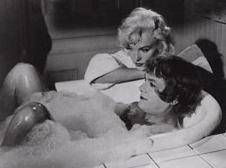 American Film Institute called it, the greatest American film comedy yet made. But Billy Wilder’s farce about desperate musicians, vicious gangsters, and straight men in drag definitely belongs in the top 20. And its closing line has never been beat. My Man Godfrey isn’t in Some Like It Hot’s class (little is), but this depression-era story of a bum-turned-butler still provides many laughs. Like all screwball comedies, it trades in both romance and class differences. It plays on class considerably more than most screwballs, perhaps a result of its time—it was made in 1936, early for a screwball but in the middle of the depression. Godfrey blows it badly in the third act, but that shouldn’t keep you from enjoying the first two.
A North by Northwest, Rafael, Sunday, noon. Alfred Hitchcock’s  light masterpiece, not as thoughtful as RearWindow or Notorious, but more entertaining than both of them combined. Cary Grant plays an unusually suave and witty everyman in trouble with evil foreign spies (who think he’s a crack American agent), and by the police (who think he’s a murderer). And so he must escape almost certain death again and again while chased from New York to Mount Rushmore. On the bright side , he gets to spend some quality time with a very glamorous Eva Marie Saint. Danger has its rewards.
A Shall We Dance, Stanford, Wednesday through next Friday. Along with Top Hat and Swingtime, Shall We Dance represents the best of what Astaire and Rogers had to offer. The story–¦well, who cares about the story. The only collaboration between Astaire, Rogers, and the two Gershwins gives us “They All Laughed,” “Let’s Call the Whole Thing Off,” dancing on shipboard, dancing on stage, dancing in roller skates, and the most romantic song ever written, “They Can’t Take That Away from Me.” When Fred and Ginger aren’t singing or dancing, Edward Everett Horton and Eric Blore provide plenty of comedy, with light satire aimed at celebrity scandals and the culture gap between ballet and popular music. On a double bill with The Sky’s the Limit, which I saw long ago and kind of liked.

 Bayflicks