And so I come to Akira Kurosawa’s last film, made five years before he died. When I watched Madadayo last night at the Pacific Film Archive, I completed my journey through all of Kurosawa’s works in (mostly) chronological order. That same screening also ended the PFA’s own, non-chronological retrospective of the same 30 films.
Madadayo never received a regular theatrical release in the United States. I saw it on DVD about 10 years ago. Last night was my second viewing of it, and my first theatrically.
A few days ago, I described Kurosawa’s penultimate film, Rhapsody in August, as “pleasant.” But compared to its successor, it’s more like King Lear (or Ran). Madadayo is so relentlessly upbeat it seldom rises above the banal. The story (and that’s way too strong a word to describe what unfolds onscreen) concerns a beloved professor who retires early to pursue a writing career. He turns 60 not long after his retirement in 1943, and the movie ends on his 77th birthday. Despite being bombed out of his home, his life between these events are extraordinarily uneventful.
Much of the film involves social calls from former students, especially four 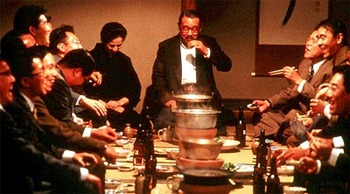 particularly close ones who appear to devote their lives to their old professor’s happiness (his wife is equally devoted). They organize annual banquets in his honor. They buy undeveloped land adjoining his house to make sure that nothing blocks the sunlight. They take time off work to help him find his cat.
Yes, Madadayo is so bereft of conflict that it devotes a full half hour to a search for a missing cat. Everyone–local schoolchildren, shop owners, the cop on the beat—get involved with the search. After all, what could be more important than finding this old couple’s cat? And the whole cat sequence ends on an anti-climax.
When they aren’t looking for missing cats, the former students enjoy their old professor’s witty comments and his clever/cute ways of discouraging miscreants. These often are witty and clever, but they never justify the oversized belly laughs of the characters onscreen. Kurosawa seems obliged to tell the audience “This is really, really funny” when something is, in fact, only mildly amusing.
It’s easy to view Madadayo as being indirectly autobiographical. Kurosawa was an old artist, beloved by much of the world, when he made this movie about an old professor, beloved by his former students. (The film is based on the memoirs of professor-turned-author Hyakken Uchida.) The protagonist is a ripe 77 when the movie ends; this was the third film Kurosawa completed after turning that age.
One wants a great artistic career to end with a masterpiece, but they seldom do. Akira Kurosawa made an astonishing number of masterpieces and near-masterpieces in his 50 years of filmmaking. But he ended his career with a movie as bland as unseasoned white rice.

 Bayflicks