I caught Agora at Berkeley’s Shattuck Theater last night. It was my first experience with one of their newly re-appointed “lounge” theaters. Both the movie and the theater disappointed.
The lounges have big, wide loveseats rather than conventional theater seats—great for![lovesac_for_shattuck_490w[1]](https://bayflicks.net/wp-content/uploads/2010/08/lovesac_for_shattuck_490w1.jpg "lovesac_for_shattuck_490w[1]") cuddling, but not of much use when you go to a movie by yourself. Nevertheless, if it wasn’t for their low backs, which made them difficult to recline in, they’d be quite comfortable. If you don’t like to sit up front, the low backs probably wouldn’t bother you.
cuddling, but not of much use when you go to a movie by yourself. Nevertheless, if it wasn’t for their low backs, which made them difficult to recline in, they’d be quite comfortable. If you don’t like to sit up front, the low backs probably wouldn’t bother you.
Speaking of reclining, four huge, immovable beanbag chairs dominate the area between the front row and the screen. I tried one. Very comfortable. I was basically lying down, my head slightly inclined on a pillow, starring almost straight up at the screen.
But even by my standards, it was too close. I ended up in a front-row loveseat, with my feet up on beanbag in front of me. That was kind of comfortable, but not entirely.
Another difference: The Shattuck now has a bar, and you can bring alcohol into the lounge theaters for night screenings.
From the moment I first read about it, I wanted to see Agora and I knew I would love it. I’m a sucker for historical epics, especially those with a modicum of intelligence, and here was one set at a time that Hollywood has generally ignored—the late, Christian Roman Empire. The story concerns a big subject–the transition from Greco-Roman antiquity to the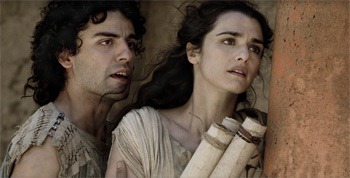 dark ages–and it stars one of my favorite actors, the beautiful and talented Rachel Weisz.
What could go wrong?
Aside from some distractingly fancy camerawork (did the camera really have to be upside down in that shot, and what were those images of Earth from space about?), nothing really does go wrong here. But no much goes right, either. Despite another fine Weisz performance, and the gutsiness involved in making a film where the Christians are the bad guys, Agora never quite catches fire.
In case you haven’t heard, Weisz plays Hypatia, a mathematician, scientist, and teacher in the great Library of Alexandria. She’s intelligent, curious, and has no interest in being subservient to men. Many men want her (of course they do; she looks like Rachel Weisz), but her only interests are intellectual. Besides, marriage would be the end of her independence. And yes, Hypatia really lived, although not much is known about her.
This all takes place in Roman-ruled Alexandria in the late fourth century. Christianity, banned only decades ago, is now Rome’s official religion. Christian mobs are getting loud, insulting, and violent. Pagans and Jews have their violent moments, as well (it’s the pagans who first draw swords), but the Christians have the numbers, the government, and their own narrow-minded bigotry on their side.
The film’s second lead, and initially it’s most interesting character, is Hypatia’s slave Davus (Max Minghella). A young man of great compassion, he clearly loves his mistress, both as a loyal and well-treated servant, and as a man attracted to an unattainable woman. She treats him very well most of the time, but occasionally will say something patronizing and insulting without even realizing it.
Davus’ natural compassion brings him into the Christian sphere, and eventually he ceases to be interesting. For the second half of the film, he shows up from time to time, looking pensive, torn, and guilty. We stop caring about him.
In fact, writer/director Alejandro Amenábar gives us precious little to care about. He shows us the deaths of hundreds of people, many of whom we’ve come to know, as well as the destruction of both a way of life and the greatest repository of knowledge the ancient western world knew, and it all feels remote. At no point does he make us feel the size and depth of that loss.
What’s worse than a bad movie. A moderately good one that, given the subject matter, should have been great.

 Bayflicks
A thoughtful review. I saw Agora when it first came out in NYC and loved Weisz’ performance as Hypatia, but agree that it has some flaws. Amenabar distorts some history in service to his art (the Library didn’t end that way and Synesius wasn’t a jerk), but that’s what artists do. For people who want to know more about the historical Hypatia, I highly recommend a very readable biography “Hypatia of Alexandria” by Maria Dzielska (Harvard University Press, 1995). I also have a series of posts on the historical events and characters in the film at my blog – not a movie review, just a “reel vs. real” discussion.