Quite a selection this week. Who says revival cinema is dead!
 Stagecoach, Pacific Film Archive, Tuesday, 7:30. How hard is it to see great westerns on the big screen these days? In the 3 1/2 years I’ve maintained this web site, this is my first chance to recommen
 d you catch John Ford’s 1939 masterpiece. Nine very different people must cross dangerous territory in the titular vehicle–a journey that forces them to confront their prejudices as well as angry Apaches. A young, impossibly handsome John Wayne made the leap from B pictures to A-list star with his performance of an escaped convict, but it’s Thomas Mitchell’s alcoholic doctor who really carries the picture. If you’re one of those people who doesn’t have to see westerns because you already know they’re not worth seeing, Stagecoach will open your mind. Part of the PFA’s United Artists: 90 Years series.
Lawrence of Arabia in 70mm, Castro, Saturday and Sunday. Lawrence isn’t just the best big historical epic of the 70mm roadshow era, it’s one of the greatest films ever made. Stunning to look at and terrific as pure spectacle, it’s also an intelligent study of a fascinatingly complex and enigmatic war hero. T. E. Lawrence—at least in this film—both loved and hated violence, and tried liberating Arabia by turning it over to the British. No, that’s not a flaw in the script, but in the character. This masterpiece isn’t worth seeing on DVD and barely worthwhile in 35mm. Shot in Super Panavision 70, it takes 70mm to reach it’s potential. And that’s how the Castro is showing Lawrence as part of its 70mm Festival.
Playtime in 70mm, Castro, Tuesday and Wednesday. Monsieur Hulot adrift and befuddled in 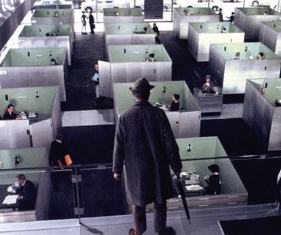 modern Paris. That’s all there is of plot in Jacques Tati’s masterpiece, and that’s all that’s needed. One of the funniest films of the 1960’s, but in an odd, almost meditative way. And even when you’re not laughing, you’re fascinated by the little details of Tati’s city-sized universe. Tati spent (and lost) a fortune on Playtime, building a giant set and shooting the movie in 65mm for 70mm release, and the result is ours to enjoy…immensely. Yup; it’s in the Castro’s 70mm series.
Steamboat Bill, Jr., Pacific Film Archive, Sunday, 5:00. One of Buster Keaton’s best, both as a performer and as the auteur responsible for the entire picture (it’s the last film in which he would enjoy such control). Steamboat Bill (Ernest Torrence) already has his hands full, struggling to maintain his small business in the wake of a better-financed competitor. Then his long-lost son turns up, not as the he-man the very-macho Bill imagined, but as a urbane and somewhat effete Keaton. You can look at Steamboat Bill, Jr. as a riff on masculinity or a study of small-town life as an endangered species. But it’s really just a lot of laughs seamlessly integrated into a very good story–and you really can’t ask for more than that. The spectacular, climatic hurricane sequence contains what’s probably the most thrilling and dangerous stunt ever performed by a major star. Judith Rosenberg provides piano accompaniment in this entry to the PFA’s United Artists: 90 Years series.
City Lights, Stanford, Wednesday, 7:30. In Charlie Chaplin’s most perfect comedy, the little tramp falls in love with a blind flower girl and befriends a suicidal, alcoholic millionaire, but neither of them know the real Charlie. The result is funny and touching, with one of the great tear-jerking endings. Sound came to movies as Chaplin was shooting City Lights, resulting in an essentially silent film with a recorded musical score composed by Chaplin himself. On a double bill with The Smiling Lieutenant.
 Show People, Rafael, Thursday, 7:00.
 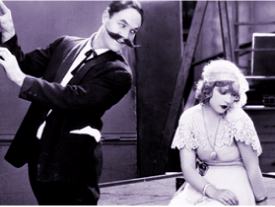 We remember Marion Davies, if we remember her at all, as William Randolph Hearst’s mistress and the inspiration for Citizen Kane’s talentless second wife. But King Vidor’s 1928 backstage-in-Hollywood comedy proves her a considerable talent. The story of knockabout slapstick versus self-consciously arty cinema must have seemed all too autobiographical to Davies, a talented comedienne whose lover and benefactor wanted to show off her class. Bruce Loeb accompanies this 35mm vault print on piano.
Thrill-O-Tronic Film Show, Cerrito, Saturday, 2:00. A weekend matinée ThrillVille event? Does that mean it’s kiddie-appropriate? Management promises “a crazy cavalcade of classic cartoons, psychotronic shorts, vintage TV shows, drive-in movie trailers and more…” With a live theremin concert by Robert Silverman.
Tron, in 70mm, Castro, Friday. I haven’t seen Tron since it was a new movie showing on very big  screens–I remember a dumb story but an entertaining light show. In those days, whatever computer geek in-jokes it contained went over my head. Today, I suspect Tron would have considerable historical interest, as it was the first feature film to extensively use what we now call CGI. It was also one of only two Hollywood films shot in 65mm between 1971 and 1992, as well as one of the last big movies about computers made before they became household appliances. As part of the Castro’s 70mm Festival, they’re showing Tron with the other Hollywood film shot in 65mm in those years, Brainstorm, which I don’t remember with anywhere near as much fondness. Part of the Castro’s 70mm Festival.
 The Wild Bunch in 70mm, Castro, Monday. Sometimes I think I’m the only male, heterosexual cinephile who doesn’t love The Wild Bunch. I don’t object to violence in movies. I even love The Good, the Bad, and the Ugly, which also presents violent, amoral protagonists and asks us to root for them. But unlike Sergio Leone’s masterpiece, The Wild Bunch takes itself seriously and even indulges in sentimentality. It’s one thing to vicariously enjoy fictional characters with few if any scruples; it’s another to get all weepy about them. Part of the Castro’s 70mm Festival.
Some Like It Hot, Pacific Film Archive, Saturday, 6:30. 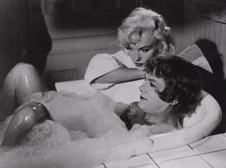 Maybe this isn’t, as the American Film Institute called it, the greatest American film comedy yet made. But Billy Wilder’s farce about desperate musicians, vicious gangsters, and straight men in drag definitely belongs in the top 20. And its closing line has never been beat. Part of the PFA’s United Artists: 90 Years series.
DOUBLE BILL: Singin’ in the Rain and Kiss Me Kate, Stanford, Saturday through Tuesday. In 1952, the late twenties were a fond memory of an innocent time, and nostalgia was a large part of Singin’ in the Rain’s appeal. The nostalgia is gone now, and we can clearly see this movie for what it is: the greatest musical ever filmed, and perhaps the best work of pure escapist entertainment to ever come out of Hollywood. While not in the same league, Kiss Me Kate isn’t half bad. But since the Stanford won’t be showing it in 3D as it was meant to be shown, it’s not much more than half-good, either.
DOUBLE BILL: Duck Soup & Animal Crackers, Stanford, 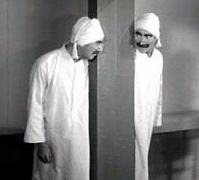 Friday (continuing from last week). In Duck Soup, a blatantly corrupt politician becomes the country’s all-powerful leader on the whim of the wealthy elite. Once in office, he cuts benefits for the working class, fills important positions with unqualified clowns, and starts a war on a whim. But how could a comedy made in 1933 be relevant today? The Marx Brothers at their very best. Like its predecessor The Coconuts, Animal Crackers is just a photographed stage play. But this second time before the cameras, the brothers perform in top form, in a play that really rides on their strengths. Technically crude, but wonderful in every other way.
Mafioso, Cerrito, Thursday, 9:15. I laughed many times, often with hearty enthusiasm, during this rediscovered “classic” 1962 Italian comedy. But I also spent too much time wondering when it was going to get funny, or at least interesting, again. The best moments come early, with the resulting culture shock when the factory manager protagonist (the great comic actor Alberto Sordi) brings his blonde wife and children to his native Sicily–a place that appears only slightly more civilized than Borat’s Kazakhstan. But director Alberto Lattuada and his five credited writers fail to either consistently keep the comic pace or layer in enough reality to hold our interest when the humor slacks off. And when Mafioso takes a serious turn in the third act, that lack of reality is nearly fatal. Billed as “A Celebration of Italian Cinema,” this screening will be hosted by Dr. Laura Ruberto, who teaches film studies at Berkeley City College.
 Iron Man, Red Vic, Saturday (continued from las
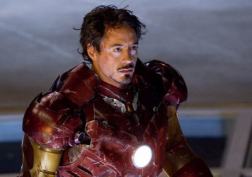 t week). Director Jon Favreau and his team of writers insert all the requisite thrills into a story strong enough to support the pyrotechnics rather than get buried by them. After a close brush with violent death, weapons tycoon, genius, and all-around jerk Tony Stark (Robert Downey Jr.) wants out of the death business. But he’s conflicted about his new-found pacifism, so he secretly builds the ultimate one-man weapon–an armored, flying suit with guns and missile launchers attached–to help him keep the peace. Favreau knows better than to fill his movie with wall-to-wall action, and always ties the well-choreographed fighting to the story. See my full review for details.

 Bayflicks