I’m back!
Well, sort of. My life has been taken over by a play I’m directing, the resurgence of an old back problem, and a professional assignment that I couldn’t refuse. The assignment is over, giving me a chance to breath again.
Unfortunately, the back problem limits the amount of time I can spend sitting down, making computer use difficult and moviegoing all but impossible.
But I’m slowly getting better, and even managed to see Letters From Iwo Jima over the weekend–my first theatrical experience since Berlin and Beyond. At least I’m going into the Oscars with every Best Picture nominee under my belt.
How do I rate the nominees? Babel’s still my first choice, although I’d be perfectly happy to see Little Miss Sunshine or Letters From Iwo Jima win. Not that either of them stands a chance. Little Miss Sunshine is, after all, a comedy, and therefore isn’t dignified enough for the award (although I’d love to see it win for just that reason). Clint Eastwood has too many relatively new Oscars to win more this year.
While Babel gets my vote, The Departed gets my bet. I didn’t like it anywhere near as much as the three mentioned above, but a lot of Academy members probably feel that it’s Scorsese’s turn. I can’t say I entirely blame them.
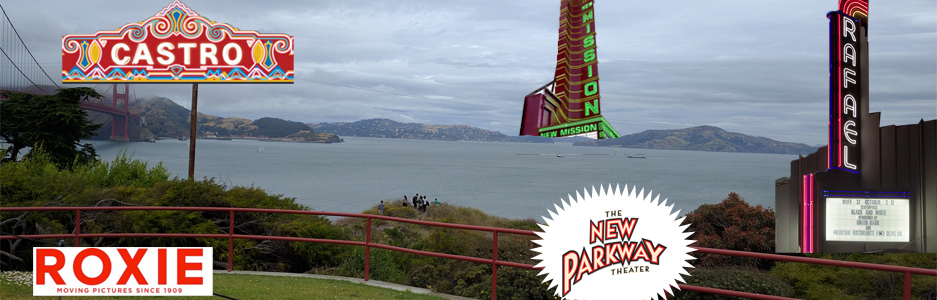
There are plenty of options for watching the Oscars in a theatrical setting. There are Oscar parties at the Balboa, the Roxie, the Lark, the Rafael, the Cerrito, and the Parkway. Some of these are sold out, already, so call ahead.
Here’s what else you can catch theatrically this week:

 Commune, Red Vic, Friday through Thursday. One expects to be depressed by a documentary on a hippie commune founded at the end of the ’60s, but Commune, thankfully, doesn’t live up to that expectation. True, the Black Bear Ranch had to cope with difficult winters, promiscuity’s inevitable problems, and even a cult that tried to make the ranch its own. But the commune is still there. True, the old-timers interviewed for the film have all left, but they all look back at Black Bear as a mostly positive experience that helped shape their lives. A pleasant yet intelligent documentary that manages to be both nostalgic and clear-eyed.
Sherlock Jr., Balboa, Tuesday, 7:30. There’s nothing new about special effects. Buster Keaton used them extensively, in part to comment on the nature of film itself, in this story of a projectionist who dreams he’s a great detective. The sequence where he enters the movie screen and finds the scenes changing around him would be impressive if it were made today; for 1924, when the effects had to be done in the camera, it’s mind-boggling. Since it’s Keaton, Sherlock Jr. is also filled with impressive stunts and very funny gags. This is an extremely short “feature,” running only about 44 minutes (depending on the projection speed). As part of its Birthday Bash, the Balboa will present Sherlock Jr., Keaton’s short subject “The Playhouse,” and some live vaudeville. Frederick Hodges will accompany the movies on the piano.
 Letters From Iwo Jima, Presidio, ongoing. I didn’t think Clint Eastwood could top
  Flags of Our Fathers, but he did…just barely. By concentrating on the Japanese experience and turning Americans into the briefly-glimpsed “other,” he forces us to consider not only the dehumanizing aspects of war itself, but also the distortions in conventional war movies. Leaving such high-minded talk aside, he tells a very sad tale of ordinary people selected for death by an exceptionally cruel government.
To Kill a Mockingbird, Cerrito, Saturday. The film version of Harper Lee’s Pulitzer Prize-winning novel manages to be both a nostalgic reverie of depression-era small town Southern life and a condemnation of that life’s dark and ugly underbelly. Gregory Peck’s Atticus Finch is the ultimate decent and moral father, a character so virtuous he’d be unbelievable if the story wasn’t told through the eyes of his young daughter. (Had a sequel was set when the girl was a teenager, Atticus would probably be an idiotic tyrant.) Part of the Cerrito Classics series.
The Lady Vanishes, Castro, Wednesday. The best (and almost the last) film Alfred Hitchcock made in England before jumping the pond. This is Hitchcock light–starting out as a gentle comedy and slowly building suspense, but never taking itself seriously. On a double bill with The 39 Steps.
Sunset Blvd., Pacific Film Archive, Wednesday, 3:00. Billy Wilder’s meditation on Hollywood’s seedy underbelly is the flip side of Singin’ in the Rain (now that would make a great double bill). Norma Desmond is very much like Lena Lamont–after twenty-two years of denial and depression. And in the role of Norma, Gloria Swanson gives one of the great over-the-top performances in history. Part of the Film 50: History of Cinema class.
Monty Python & the Holy Grail, Shattuck, Friday and Saturday, midnight. Bump your coconuts together and prepare the Holy Hand Grenade, but watch out for the Killer Rabbit (not to mention the Trojan one). The humor is silly and often in very bad taste, and the picture has nothing of substance to say beyond ridiculing the romantic view of medieval Europe. But the Python’s first feature with an actual story (well, sort of) keeps you laughing from beginning to end.
The Last King of Scotland, Balboa, opens Friday. The “King” in the title refers to  Ugandan dictator Idi Amin, played by Forest Whitaker in a performance that may finally win him that Oscar he’s so long deserved. Whitaker shows us all the sides of a paranoid megalomaniac, at one moment winning us over with his easy-going charisma and the next leaving us shaking in fear. We get to know him through the eyes of a young Scottish doctor (James McAvoy) who accidentally falls into Amin’s inner circle and gets seduced by the good life. The film doesn’t give you much reason to like McAvoy’s character–even when doing the altruistic work that brought him to Africa he seems shallow and self-centered–but you care if he lives or dies. And that becomes a real issue as this political character study gradually turns into an thriller. My big complaint: The ending is a moral cop-out. On a double-bill with Venus.
 Babel, Presidio, ongoing. A stupid act committed by a boy too young to understand the consequences sends shockwaves around the world, affecting the lives of an American tourist couple in Morocco, an immigrant nanny in the United States, her family in Mexico, an alienated deaf-mute teenager in Japan, and the boy’s own family. Writer Guillermo Arriaga and director Alejandro González Iñárritu weave a complex, four-strand tale of love, tragedy, parental responsibility, and the borders–political, economic, linguistic, and emotional–that separate us all. In the end, Babel (an appropriate title for a film told in Arabic, English, Spanish, Japanese, and Japanese sign language) hails the incredible human ability to heal. The cast, which ranges from major international stars (Brad Pitt, Cate Blanchett, Gael García Bernal, Kôji Yakusho) to complete novices, is uniformly excellent. Emotionally draining yet exhilarating, and filled with an intense love of humanity that never ignores our weaker selves, Babel is easily the best new movie I saw in 2006.

 Bayflicks