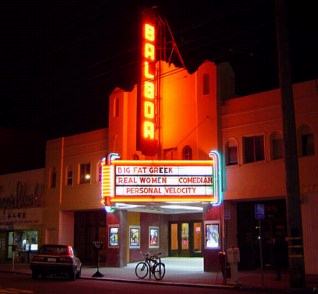
Gary Meyer of the Balboa wrote a decidedly depressing newsletter last week. In case you don’t subscribe, you’ll find it on his Web site’s Latest News page. Scroll down to “NO NEW CALENDAR?”
 |
| Courtesy of Patrick Crowley |
Meyer informed his theater’s fans that the Balboa cannot continue its programming policy of classics and little-known independents. The audience for the old and offbeat, according to Meyer, simply isn’t there. “To cover the film rental and other costs of showing classics, we need an average of 200 people a day. In reality it has been more like 60. We are not alone. San Francisco audiences are simply not attending classic films at any theaters on a regular basis.”
I can’t claim Meyer’s expertise, but my experience last weekend seems to contradict that statement. I spent Saturday at the Castro for the San Francisco Silent Film Festival. The crowds were huge. The final presentation of the night, Pandora’s Box, sold out the 1,600-seat theater. And its not just the live music. The Castro’s 2005 70mm festival was a sufficiently big hit to justify a sequel next month.
Of course, the Castro has two advantages over the Balboa: It’s centrally located, and it’s a huge, elaborately decorated palace with a giant screen, a great sound system, and now- unique capabilities like 3D and 70mm. The theater is almost as much of a draw as the movie. That simply isn’t the case with the Balboa.
That’s really too bad, as Meyer is probably the best programmer working in the area. Aside from bringing Best of Youth to Bay Area moviegoers, he’s put together several great repertory series at the Balboa, and brought some interesting people to talk about them.
For the time being, the Balboa will show second-run Hollywood and indiewood films, mostly on double-bills (something that makes it almost unique these days). There are some special presentations planned for the fall, including a Janus film festival, a Louise Brooks series, and the John Barrymore silent version of Dr. Jekyll and Mr. Hyde, which will have live accompaniment by the Devil Music Ensemble.
Speaking of silent films (and Louise Brooks), some quick comments on my day at the Silent Film Festival: Bucking Broadway was fun, and while it showed a strong visual flare, you’d never guess that its director (John Ford) would go on to become the greatest of all western auteurs. No one could reasonably call the Mary Pickford melodrama Sparrows a great film, but it is a gorgeous one, all the more so in a newly-restored and tinted print. Pandora’s Box, on the other hand, is a great film, and Clark Wilson did a splendid job accompanying it on the Castro’s organ. The print, however, was a disappointment.
 But the big, delightful surprise was Julien Duvivier’s Au Bonheur Des Dames, a little-known 1930 Emile Zola adaptation about a giant department store and the people it displaces. If it wasn’t for the total cop-out of an ending (possibly inserted at the studio’s insistence), Au Bonheur Des Dames would equal The Crowd as the greatest serious drama of the silent era. The Hot Club of San Francisco‘s accompaniment was as good as the movie.
Unfortunately, Au Bonheur Des Dames isn’t easily available in this country. The print screened Saturday, from the Cinémathèque Française, had the original French titles, which were translated orally in the theater. So if you weren’t there, you may have missed that one for good.
But here are some movies you can still make:
Recommended: Sunrise: A Song of Two Humans, Pacific Film Archive, Friday, 7:00. Haunting, romantic, and impressionistic, F. W. Murnau’s first American feature turns the mundane into the fantastic and the world into a work of art. The plot is simple: A marriage, almost destroyed by another woman, is healed by a day in the city. But the execution, with its stylized sets, beautiful photography, and talented performers, makes it both touchingly personal and abstractly mythological. Basically a silent, Sunrise was one of the first films released with a soundtrack (music and effects, only), and that’s how the PFA will present it. The PFA’s other film for the evening (not quite a double bill, as separate admission is required, but there’s a discount if you see both) is 7th Heaven; same studio, same star, same year, and also with a “silent” with a recorded musical score. Both are part of the PFA’s Janet Gaynor series.
Recommended: Wallace & Gromit in Curse of the Were-Rabbit, Old Mill Park, Mill Valley, Friday, 8:30. An eccentric inventor, his long-suffering dog, snooty aristocrats, cute bunnies, and whole lot of clay make up the funniest movie of 2005. I vote for putting this G-rated, claymation extravaganza on a double-bill with that other hilarious British comedy with killer rabbits, Monty Python and the Holy Grail. Unfortunately, this will be a DVD presentation.
Not Recommended: Cars, Balboa, opens Friday. So much for the animation studio that could do no wrong. Pixar’s first bad movie suffers from two inexcusable faults. First, the protagonist is neither likeable nor interesting, despite being voiced by Owen Wilson, who is quite capable of being both. And second, the 116-minute picture is too long for its few laughs and predicable characters. Cars provides plenty of opportunity for wandering minds, and mine wandered towards some very basic problems with the premise. These wouldn’t have bothered me in an entertaining picture. On a double-bill with Water, which I haven’t seen but suspect is a very different kind of movie.
Recommended: Who Killed the Electric Car?, Parkway, opens Friday. In the mid-90’s, General Motors released an electric car so wonderful that Chris Paine made this  documentary about it. But GM leased these cars rather than selling them, and very few people got their hands on one. Then GM pulled the plug (so to speak) on the entire line, ceasing production and reclaiming all existing cars. Paine turns all of this into an informative, very partisan, yet breezy documentary. Interview subjects include a GM saleswoman turned activist, NIMH battery inventor Stanley Ovshinsky, and movie stars who were among the few people allowed to lease these cars (this may be the only progressive documentary with a positive image of Mel Gibson).
Not Recommended: Vertigo, Stanford, Saturday through Monday. What? I’m not recommending Vertigo? Everyone else thinks it’s a masterpiece, but it’s on my short list of the Most Overrated Movies of All Time. Vertigo isn’t like any other Hitchcock movie; it’s slow, uninvolving, and self-consciously arty. On a double-bill with To Catch a Thief, discussed below.
Recommended, with Reservations: To Catch a Thief, Stanford, Saturday through Monday. More like a vacation on the Riviera than the tight and scary thriller one expects from the master of suspense. Not his best work by a long shot, but it has a few good scenes and thus sufficient fun. Besides, 106 minutes of Cary Grant and Grace Kelly in Monaco, photographed in the beauty of VistaVision, can’t be all bad. On a double-bill with Vertigo.
Noteworthy: Harold and Maude, Red Vic, Sunday through Wednesday. After Woodstock, this comedy about a young man and a much older woman is the ultimate statement of the hippie generation. I loved it passionately in the 1970’s, but I haven’t seen it in a long time and I’m not sure how well it’s aged.
Not Recommended: Roots (2005), Castro, Tuesday, 12:00 noon. I hate watching great  ideas made into bad movies. Any competent laughsmith could have made a hilarious farce out of this story of a conman who pays Ukrainian villagers to pretend they’re the long-lost relatives of western Jewish tourists. A really talented one could have mixed real pathos in with the laughter. Alas, writer Gennady Ostrovsky and director Pavel Loungin are neither talented nor competent. Roots (not to be confused with the American miniseries) is slow, plodding, nearly laughless, and lacks a single likeable nor interesting character. And the love story subplot is about as romantic and sexy as a colonoscopy. Part of the Jewish Film Festival.
Recommended: Forgiving Dr. Mengele, Castro, Tuesday, 5:00. “Getting even has never healed a single person.” I didn’t think there was anything new for a Holocaust documentary to say, but then I’d never before seen one about Eva Mozes Kor. A survivor of Mengele’s notorious “experiments” at Auschwitz, and now a real estate agent in Indiana, Kor devotes herself to keeping the memory of the Shoah alive, even running a small museum in her adopted home town. Yet this feisty little woman has done something else altogether remarkable, and controversial among survivors. She has publicly forgiven the mass murderers who killed her family and turned her childhood into a living hell. An expertly-made documentary about a remarkable human being. Part of the Jewish Film Festival.
Recommended: Local Call!, Castro, Tuesday, 10:00. What’s scarier than your dead father calling you constantly from beyond the grave? The phone bills. That’s what Sergio Castellitto discovers in this very funny French comedy that appears to be inspired by the Book of Job. As his father (voiced by Michel Serrault) continues to harass him about a coat, and the phone bills send him into poverty, every other aspect of his respectable, middleclass life falls apart. Director/co-writer Arthur Joffé meditates hilariously on memory, communication, Jewish spirituality, and the precariousness of our comfortable lives. Part of the Jewish Film Festival.

 Bayflicks